1905 Moscow Demonstration and Dragoon Massacre
Doctor ZhivagoThe 1905 Moscow Demonstration and Dragoon Massacre turns a demonstration called after the October Manifesto into a cavalry attack that breaks up the march. The episode moves from disorganized planning to a warning the crowd cannot absorb, then from public assembly to sudden flight. Its immediate human consequence is the separation of Marfa Tiverzina and Pasha Antipov, whose reunion closes the scene without undoing the violence that has scattered the demonstrators.
Causes and Preparation
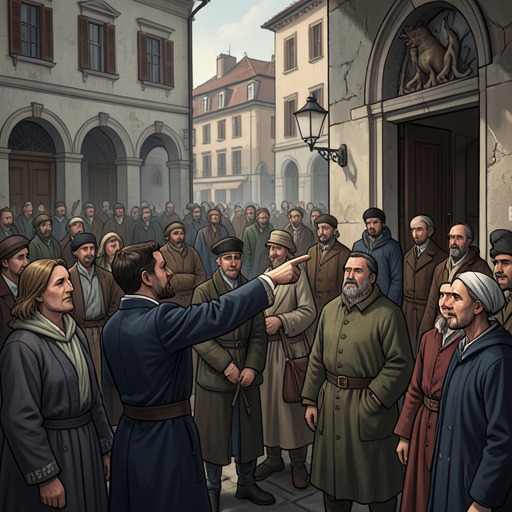
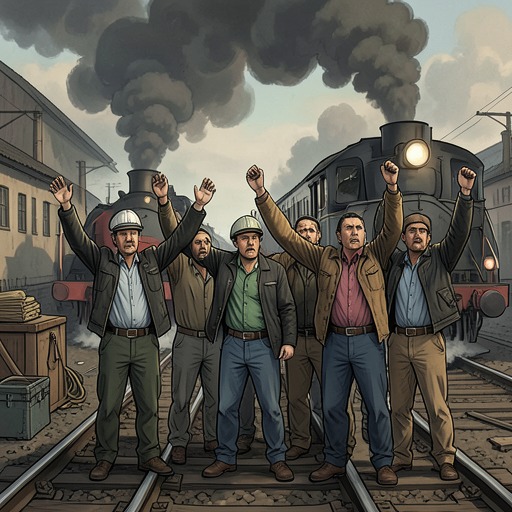
After the October Manifesto, several revolutionary organizations called for a large demonstration, planned to march from the Tver Gate to the Kaluga Gate across Moscow. The organizers quarrelled, however, and withdrew one by one. When they learned that crowds had gathered on the appointed morning regardless, they hurriedly sent representatives to lead them. The demonstration thus began not with a unified plan but with a belated attempt to manage an event already in motion.
Marfa Tiverzina joined the march despite her son Kuprian’s efforts to dissuade her, and Pasha went with her. He was cheerful and observant, known for amusing those around him with imitations; during the march he would mimic a speaker for Marfa. Their presence places a family bond within the larger gathering, where a crowd made up of students, workers, railwaymen, children, and others moves together through the city.
The March and the Warning
The procession advanced along a street filled with demonstrators, singing the "Marseillaise," the "Varshavianka," and "Victims You Fell." At its head, a man who had been conducting with his cap stopped to listen to the other leaders. The singing fell into disorder, and the sound of many footsteps replaced it. The shift from song to silence marks the moment when the march’s shared momentum is interrupted by information from outside it.
Sympathizers warned the leaders by telephone, through a nearby pharmacy, that Cossacks were waiting to ambush the procession farther down the street. The organizers responded by urging calm and proposing that the demonstrators occupy the first public building they came to, warn those inside, and disperse. They argued over which building to enter. When the crowd was eventually shepherded into an auditorium, the warning did not take hold: people treated the stop as the beginning of a meeting, and the impromptu gathering proceeded instead.
The crowd welcomed the chance to rest and listened to speakers, applauding even the least effective orator without much attention to his words. A protest telegram was drafted amid shouts of disapproval, but impatience overcame the meeting. The demonstrators rose together and poured out of the building, resuming the procession. By then the snow had begun to fall more heavily, whitening the street as the march continued toward the danger the leaders had tried to announce.
The Cavalry Attack and Dispersal
When the dragoons charged, people at the rear initially did not know what was happening. Noise rolled back through the crowd: cries of "Hurrah" mingled with individual calls for help, and the riders passed swiftly through the corridor formed as the demonstrators divided. Half a platoon galloped through, turned, re-formed, and cut into the rear of the procession. The attack transformed the march into a flight, with the violence first reaching some demonstrators as sound before the riders came into view.
Within minutes, the avenue was almost empty as people scattered into side streets. The snowfall eased, and the setting sun picked out red details against the snow: the tops of the dragoons’ caps, a flag trailing on the ground, and traces of blood. The account’s attention to these remnants gives the scene a stark aftermath: the organized procession has vanished, leaving scattered people and signs of the attack in its place.
Marfa and Pasha
In the aftermath, Marfa ran from side to side calling for Pasha. He had disappeared in the confusion while entertaining her with his imitation of the last speaker. A dragoon’s blow had struck her, but her attention remained on finding the boy. She eventually spotted him across the street, where he had been caught among passers-by hemmed in by a mounted rider. When the dragoons rode back, that rider rejoined them, and Pasha, too frightened to speak, rushed to Marfa after the crowd dispersed.
Marfa grumbled all the way home, condemning the dragoons and accusing them of twisting the freedom the Tsar had granted. Her anger extended beyond the cavalry to the troubles around her, and in her temper she blamed what she called Kuprian’s bunglers and fumblers. The episode therefore ends not with the demonstration restored or its warning heeded, but with a mother and boy reunited amid Marfa’s continuing outrage. Their return home supplies a private ending to a public catastrophe while leaving the larger political conflict unresolved.